
Article at a Glance
- In Georgia, the baseline withholding tax rate on payments to non-residents is 5%, but holders of international IT company status or Free Industrial Zone (FIZ) participant status can reduce it to 0%. Notably, the country imposes no restrictions on paying dividends to offshore zones.
- In Cyprus, the baseline rate for non-residents is 0%, but many payments to individuals or entities registered in low-tax offshore zones or EU blacklist countries face elevated withholding taxes of 5%, 10%, or 17% depending on the scenario.
- In Malta, withholding tax on payments to non-residents is generally 0% by default. However, among all compared participants, Malta imposes the highest corporate profit tax at 35% compared to 15% in Georgia and Cyprus.
What You Need to Know About Tax Leakage
Opening a business abroad or structuring an international holding through a network of subsidiaries inevitably exposes you to Withholding Tax Leakage.
This term describes shareholder financial losses caused by Withholding Tax (WHT). WHT is withheld on both domestic and cross-border payments—predominantly passive income such as dividends sent to a parent structure, interest on foreign loans, or royalties for software and patent usage.
Broadly speaking, withholding tax is an administrative mechanism obligating a local company to act as a tax agent when paying out funds to individuals or legal entities (regardless of residency). While this saves the state from collecting taxes directly from recipients, it can cost organizations millions of dollars annually in tax leakage.
Choosing jurisdictions with minimal withholding taxes helps mitigate this fiscal burden. This article examines three popular jurisdictions among global founders: Georgia, Cyprus, and Malta.
How Withholding Tax is Calculated in Georgia
Under Georgia’s Tax Code, the baseline WHT rate is 5%, but depending on payment types, organization status, or recipient, a more complex scale applies with rates of 0, 10, 15, and occasionally 20%.
Dividend payouts by a Georgian company are relatively straightforward, featuring only two possible rates: 0% and 5%. Full exemption from withholding tax on profit distribution is available in two main cases:
- A 0% rate applies to entities with special statuses: investment companies, international IT companies, and Free Industrial Zone (FIZ) participants.
- Complete exemption applies if dividends are paid to the Georgian state, licensed financial institutions in Georgia, and other resident legal entities.
Beyond dividends, withholding tax applies to interest on loans, royalties, and other cross-border operations.
| 0% | 5% | 10% | 15% | 20% |
| Payments to Georgian financial institutions or the state; payments on debt securities (bonds) traded on global exchanges; any interest if the payer is a Georgian FIZ participant; any interest if the recipient is a Georgian resident legal entity. | Other payments to non-resident individuals and legal entities without a permanent establishment in Georgia. | — | Increased rate for interest paid to individuals and legal entities registered in offshore zones. | — |
| 0% | 5% | 10% | 15% | 20% |
| Payments to the state; payments to Georgian resident legal entities. | Payments to any non-residents if their income is not connected to a local permanent establishment. | — | Payments to entities registered in offshore zones. | Payments to Georgian resident individuals who are not VAT payers. |
| 0% | 5% | 10% | 15% | 20% |
| Payments for non-resident contractor services if performed entirely remotely (outside Georgia). | — | Payments to non-resident contractors whose income is sourced in Georgia (physically performed in-country and/or requiring local expenses); international telecom or transport services; rental payments to foreign companies (with exceptions). | Payments to entities registered in offshore zones. | Salary payments to non-residents for work performed in Georgia. |
WHT in Georgia boils down to a few core principles: taxes are typically omitted when paying local companies, while most non-residents face a 5% rate. To avoid this entirely, companies can acquire international IT company status or FIZ participant status.
Key Insight: Businesses should avoid paying royalties and interest into offshore zones, which the Georgian government defines across 50+ jurisdictions. One criterion for these zones is a general corporate tax rate not exceeding 5% (one-third of Georgia’s standard corporate tax). On the other hand, Georgia remains attractive if you plan to distribute dividends to offshore entities, as elevated rates do not apply there.
What is the Withholding Tax in the Republic of Cyprus?
In Cyprus, withholding tax is regulated by the Income Tax Law and the Special Defence Contribution (SDC) Law (which often substitutes for or functions alongside WHT). Similar to Georgia, rates include 0, 5, 10, and 17%, applied under specific conditions.
Dividend payouts by a Cyprus tax-resident company:
- 0% is the baseline rate for profit distributions to foreign companies or non-resident individuals, as well as local entity-to-entity payments.
- 5% applies when dividends go to Cyprus tax-resident individuals (domiciled) or related legal entities from low-tax jurisdictions (LTJ) where corporate tax is less than half the Cyprus rate (<7.5%).
- 10% applies to hidden dividends (e.g., personal use of company assets by beneficiaries).
- 17% applies if profits are distributed to related companies registered in EU blacklist jurisdictions (BLJ). As of 2026, this list includes 10 countries, such as Russia, Vietnam, Panama, Vanuatu, and the British Virgin Islands.
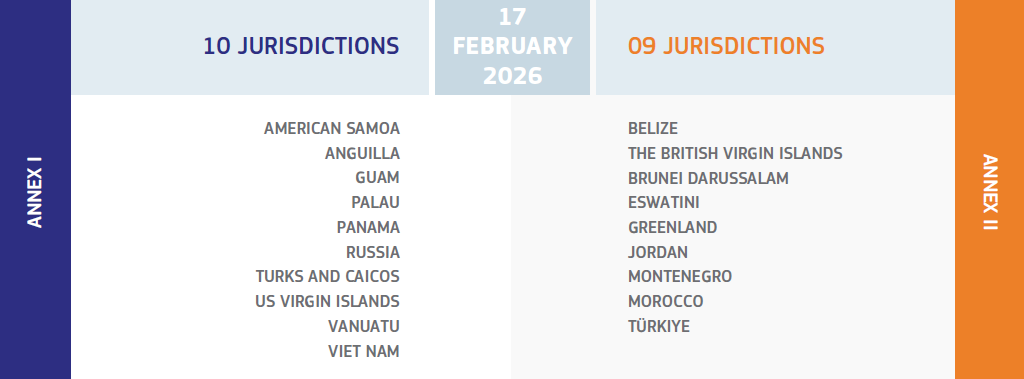
Interest payments feature two WHT rates: 0% or 17%. The 17% rate targets related blacklist companies and domiciled Cyprus tax-resident individuals (though residents can reduce it to 3% on listed bonds). Other interest payments are tax-free.
Royalty payments feature two rates: 0% and 10%. Exemptions apply for payments to related EU companies and when intellectual property rights are used outside Cyprus. If rights are used inside Cyprus by non-residents, a 10% rate applies, as it does for EU blacklist companies.
Contractor service fees carried out entirely remotely or provided by a non-blacklist legal entity incur 0% WHT. If services are rendered by a non-resident individual physically in Cyprus, the rate is 10%.
Note on related entities in Cyprus: For EU entities (e.g., qualifying for 0% royalty WHT), related status requires greater than 25% ownership. For blacklist jurisdictions, the threshold is higher at greater than 50% ownership.
Brief Takeaway: Cyprus is convenient for cross-border operations as long as the destination is not an offshore or EU blacklist zone, which triggers elevated WHT rates of 5% or 17%.
Features of Withholding Tax in Malta
Malta’s withholding tax is governed by the Income Tax Act (Chapter 123 Laws of Malta). It offers the simplest framework among the compared jurisdictions: nearly all payments to non-residents (both individuals and legal entities) are exempt from withholding tax (0%). This covers dividends, interest, and royalties alike.
An elevated 15% rate applies only to Malta tax residents in specific instances, such as certain untaxed account dividend payouts or public bond investment income. Foreign contractor payments may sometimes trigger rates up to 25% or 35% if the income is legally sourced inside Malta, but remote collaboration generates no WHT.
Note on Malta’s imputation system: Malta utilizes an imputation system requiring local companies to apply grossing up on dividends. Dividend certificates state gross dividends before corporate tax deduction, though net amounts hit the bank account. Non-resident shareholders can claim a substantial tax refund (typically 6/7ths of the 35% corporate tax) by registering with the Malta tax authorities.
Brief Takeaway: Malta offers the most welcoming non-resident withholding tax environment, even for offshore distributions. However, these benefits are counterbalanced by Malta’s overall strict fiscal policies and high headline corporate tax rates.
Final Observations on Tax Leakage
All three countries allow companies to lower withholding tax to 0% under various conditions, making Georgia, Cyprus, and Malta viable for structuring international business. Double tax treaties unique to each jurisdiction can further optimize tax exposure.
General domestic legislation also plays a crucial role. For example, Cyprus levies a 15% corporate income tax (CIT) regardless of profit distribution (prior to January 2026, it was 12.5%). Malta enforces a 35% CIT. These baseline taxes heavily impact net dividends reaching beneficiaries unless mitigated by specialized regimes.
By comparison, Georgia utilizes an Estonian-style tax model, exempting local companies from corporate income tax until profits are distributed. Furthermore, specific statuses eliminate CIT even during capital extraction: virtual and FIZ zones enjoy a 0% CIT, while international IT companies pay just 5% (with exemption from dividend tax).
Would you like to analyze how double tax treaties or specific corporate structures apply to your international business model across these jurisdictions?