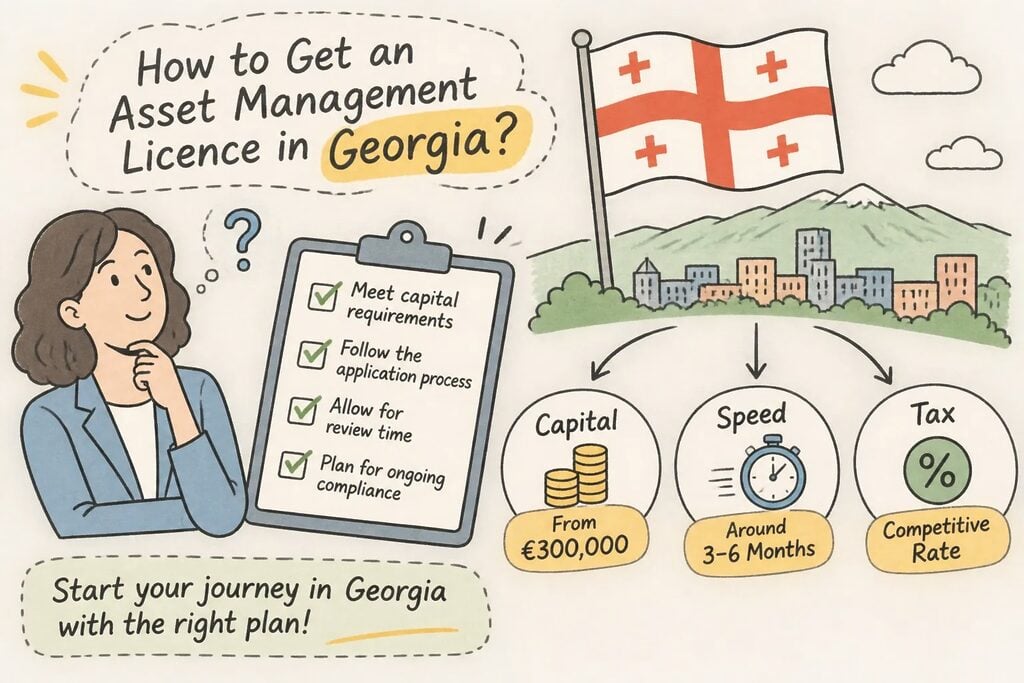
An asset management company in Georgia is a company that the National Bank of Georgia (NBG) licenses or registers to manage investment funds and other people’s money. A full asset management license in Georgia requires a local LLC or JSC, at least GEL 300,000 of own capital and qualified managers. A lighter registration needs no capital. Either route takes about 4 to 6 months, with state fees from GEL 2,000.
This guide covers the whole path: which type of manager you need, which funds it can run, the license requirements and documents, the timeline, the costs, your obligations after licensing and the tax rules. It is based on the Law of Georgia on Investment Funds and NBG Order No. 167/04 of 22 September 2020 (the “Rule”).
Key Takeaways
- Regulator: The National Bank of Georgia (NBG) licenses, registers and supervises every asset management company in Georgia.
- License or registration: A license covers public and private funds, individual portfolios, investment advice and pension schemes. A registration covers private funds only.
- Capital: A licensed manager needs at least GEL 300,000 of own capital, paid in before filing. A registered manager needs none.
- State fees: GEL 3,000 for a license or GEL 2,000 for a registration, plus GEL 5,000 per public fund or GEL 2,000 per private fund.
- People: Directors need relevant higher education, at least 4 years of financial-sector experience and a clean record. Owners of 10% or more are vetted too.
- Timeline: The NBG decides within 45 working days (+15). The full process takes about 4 to 6 months, plus 9 to 12 weeks for the first fund.
- Tax: The manager pays 15% profit tax only on distributed profit, and common funds are tax-transparent.
Why Set Up an Asset Management Company in Georgia?
- European-style law. The Law on Investment Funds follows the EU model, including a UCITS-type public fund. Public or private funds, with or without their own legal personality, are all possible.
- One supervisor. The NBG handles licensing, registration, reporting and supervision. You deal with one authority.
- Low entry costs. State fees are GEL 3,000 for a license and GEL 2,000 for a registration. A registered manager needs no minimum capital.
- Fixed deadlines. The NBG decides within 45 working days of a complete application, extendable by 15. If it misses the deadline on a license, the license is deemed granted.
- A tax regime for funds. Common funds are tax-transparent, and gains on units of an exchange-listed public fund are exempt.
License, Registration or Recognition: Three Types of Manager
Georgian law recognizes three types of asset management company. Your choice decides which funds you can run, how much capital you need and how many policies you must write.
| Licensed manager | Registered manager | Recognized manager | |
| Admission | Full license | “Light” registration | Recognition of a foreign licensed manager |
| Legal form | LLC or JSC, registered and managed in Georgia | LLC or JSC, registered and managed in Georgia | Branch of a foreign company |
| Funds it may manage | Public and private funds, foreign funds, pension schemes | Private (registered) funds only | Funds set in the NBG’s decision |
| Minimum capital | GEL 300,000 | None | Branch capital, if it manages a public fund |
| State fee | GEL 3,000 | GEL 2,000 | — |
| If the NBG misses its deadline | License deemed granted | No deemed approval | No deemed approval |
Choose a license if you plan a public fund, individual portfolio management, investment advice or pension schemes. A registration is enough for private funds only. Recognition suits groups already licensed in the EU or another developed market.
Starting light closes no doors: a registered manager can later move to a license (Law on Investment Funds, Art. 21(2)).
Which Investment Funds Can a Georgian Manager Run?
Funds differ on two axes: who can buy the units, and whether the fund is a legal entity.
Authorized (public) funds may be offered to anyone, including through advertising. A prospectus and key investor information are mandatory, and the authorization fee is GEL 5,000. They include UCITS funds, which invest only in liquid assets, and more flexible funds for non-sophisticated investors. A registered manager cannot run them.
Registered (private) funds may be offered only to sophisticated investors plus no more than 20 non-sophisticated investors. The rules are much lighter, and the registration fee is GEL 2,000. Sophisticated investors include individuals with verified assets above GEL 3 million or annual income above GEL 200,000 over the last 3 years, financial institutions and companies with capital above GEL 1 million.
On legal form, an investment company is a fund that is itself a legal entity (a JSC, or for closed-ended private funds also an LLC or limited partnership). It can appoint a manager or manage itself. A common (contractual) fund, often called a “pai” fund, is a pool of assets created by contract and always needs a manager.
Funds can also be open-ended, interval (redemptions at least once a year) or closed-ended, which suits real estate and private equity. An umbrella fund holds several ring-fenced sub-funds with separate strategies.
What a Licensed Asset Management Company Can Do
The law lists every permitted activity; anything else is prohibited (Law on Investment Funds, Art. 25). Every manager performs two core functions, portfolio management and risk management, which must be kept separate. It may also handle fund administration, sell fund units and, for non-UCITS funds, manage real estate or advise the fund’s portfolio companies.
Beyond funds, the license type decides your extra revenue streams:
| Activity | Licensed | Registered |
| Individual (discretionary) portfolio management | Yes | No |
| Management of pension schemes | Yes | No |
| Investment advice | Yes | No |
| Safekeeping and administration of fund units | Yes | No |
| Managing a securitization special purpose entity | Yes | Yes |
| Payment initiation and account information services | Yes | Yes |
Investment advice normally needs a brokerage license in Georgia, but a licensed manager is covered by its own license. Declare every extra activity in the application (Annex No. 3): adding one later needs the NBG’s consent. A recognized branch may carry out these activities only if its recognition decision allows them.
Asset Management License in Georgia: Requirements
The NBG checks four things. Form and people apply to every manager; capital and organization apply to licensed managers only.
1. Legal form and location
The manager must be an LLC or a JSC, registered in Georgia and actually managed from Georgia: a real office, with decisions taken here.
2. Fit-and-proper managers and owners
Every director and supervisory board member needs (Rule, Art. 5):
- higher education in economics, finance, banking, business administration, audit, accounting, law or a related field;
- at least 4 years in a relevant financial-sector position;
- a good business reputation and enough time for the role.
The NBG also vets every owner of 10% or more and the ultimate beneficial owner. A conviction for a grave or economic crime, money laundering or terrorist financing disqualifies a person. So does a gross financial-sector violation penalized in the last 5 years.
3. Minimum capital: GEL 300,000
At least half of the initial contribution must be cash; the rest may be property, valued under IFRS and agreed with the NBG in advance. The capital must be paid in before you file, with proof of its source. Capital is not a fee: it stays the company’s property and can fund operations while it stays above the minimum.
As you grow, add 0.01% of managed portfolios as capital, or hold professional liability insurance instead. Above GEL 250 million under management, add 0.02% of the excess.
4. Organization and internal policies
A licensed manager needs IT and information security, compliance control and a full policy set (Rule, Art. 7(7)). This covers risk management, valuation, remuneration, conflicts of interest, accounting, complaints, business continuity, record keeping, order handling, personal transactions, investment compliance and voting rights. Risk management must be independent of portfolio management, and assets must be valued independently under IFRS and GIPS.
Documents Required by the National Bank of Georgia
You file a written application with the NBG’s standard form (Annex No. 1) and five groups of documents (Rule, Art. 3). A registered manager files a lighter package.
| Group | Main documents | Registered manager |
| Company | Registry extract, charter, office ownership or lease, proof of management in Georgia, group structure if any | Same |
| Owners (10%+ and beneficial owners) | Declaration, ID, CV, criminal record certificates from every country of the last 10 years, source of funds; for companies, registration documents and audited accounts | Same |
| Management | Declaration, ID, diploma, CV, two reference letters, criminal record certificates, conflict-of-interest statement, the company’s vetting confirmation | Same |
| Business plan and policies | Business programme, list of additional activities, remuneration policy, outsourcing agreements if any | No activities list or remuneration policy |
| Finance | Proof and source of capital, current balance sheet, audited financial statements, fee payment | No capital proof |
Three practical points save time:
- New companies: if you file within 6 months of incorporation, no audited financial statements are needed.
- Certificate validity: a Georgian criminal record certificate must be under 15 days old at filing, a foreign one under 60. Order them last.
- Foreign documents: each needs an apostille or legalization and a notarized Georgian translation.
How to Get an Asset Management License: Step by Step
- Choose the structure. License or registration, the fund type, and every extra activity you will offer.
- Incorporate the company. Register the LLC or JSC and open a bank account (3 to 4 weeks).
- Pay in the capital (licensed only). Deposit at least GEL 300,000 and document its source, in parallel with step 4.
- Prepare the package. Business programme, policies, owners’ and managers’ packages, translations and apostilles.
- Check and file. Review the package internally, pay the fee and file with the NBG.
- Answer the NBG. If anything is missing, the NBG sets a deadline of at least 5 days to fix it.
- Launch the fund. Once licensed or registered, file your first fund; its review adds about 9 to 12 weeks.
| Stage | Licensed | Registered |
| Incorporation and bank account | 3–4 weeks | 3–4 weeks |
| Documents, policies, translation, apostille | 6–10 weeks | 4–6 weeks |
| Paying in capital | 1–2 weeks, in parallel | Not required |
| NBG review (45 + 15 working days) | 9–12 weeks | 9–12 weeks |
| Total | About 4.5–6 months | About 4–5 months |
The NBG’s clock starts only when the package is complete. A careful check before filing is the best way to speed things up.
Costs and Structures Compared
State fees are one-off: GEL 3,000 for a manager license, GEL 2,000 for a manager registration, GEL 5,000 to authorize a public fund and GEL 2,000 to register a private fund. The table shows what each common structure needs in fees and capital, and how long it takes from zero.
| Structure | Best for | Fees + required capital | Timeline |
| Licensed manager + public fund | Funds for the general public, e.g. UCITS | GEL 308,000 | 7–9 months |
| Licensed manager + private fund | Private funds now, public products later | GEL 305,000 | 7–9 months |
| Licensed manager, no fund | Individual portfolios, advice, pensions | GEL 303,000 | 4.5–6 months |
| Registered manager + private fund | Private investors, several funds, low cost | GEL 4,000 | 6–8 months |
| Self-managed private investment company | A single private fund, simplest route | GEL 2,000 | 3.5–5 months |
| Existing licensed manager + your fund | Fastest start, without your own manager | GEL 2,000–5,000 + manager’s fees | 3–5 months |
The figures exclude professional services, audit, the specialized depositary, office, translation and notary costs. Remember that the GEL 300,000 is capital, not an expense.
Which route should you take?
We usually recommend your own manager. It is a platform for several funds, keeps the management fee and decisions in your hands, and gives investors the comfort of NBG supervision.
- Path A, step by step: a registered manager (GEL 2,000, no capital) with a private fund. Test investor interest, then upgrade to a license.
- Path B, full start: a licensed manager with GEL 300,000 of capital, open to every fund and service from day one.
If your first investors are a private circle, Path A is usually best. If you already plan a public fund, individual portfolios or advisory services, Path B saves time.
After the License: Ongoing Obligations
A license or registration starts continuous NBG supervision.
| Obligation | Deadline or rule |
| Annual audited financial statements + management report | Within 90 calendar days of year-end; public interest entity auditor; published by the NBG |
| Quarterly IFRS financial statements | Within 30 calendar days of quarter-end; published by the NBG |
| Material events (capital shortfall, portfolios above GEL 250 million, an owner or director no longer qualifying) | Report within 3 working days; a capital shortfall needs a recovery plan |
| Outsourcing a function | Notify the NBG 10 days in advance; responsibility stays with the manager |
| New director, charter change, new holding of 10%, 25% or 50% | Prior NBG consent; decided within 1 month (+1) |
| Records | Keep for at least 6 years |
| Anti-money laundering | Client identification, suspicious transaction reports and periodic reporting |
The NBG can revoke a license for false information, unmet requirements or serious violations. It can also revoke it if business does not start within 12 months of licensing or stops for more than 6 months.
How Asset Management Companies and Funds Are Taxed
The manager is taxed like any Georgian company. Funds and investors follow special rules in Article 23¹ of the Tax Code.
- Manager profit tax: 15%, only on distributed profit. Profit kept in the company is not taxed.
- Salaries: 20% income tax withheld, plus pension contributions of 2% from the employer and 2% from the employee.
- VAT: fund management, administration and depositary services are financial services and generally VAT-exempt. Check other fees, such as advice, separately.
- Dividends to the manager’s owners: 5% withheld at source for individuals and non-residents.
- Common fund: tax-transparent. Profit is taxed at investor level, and the manager keeps a profit-and-loss record for each investor.
- Investment company: distributed profit is taxed at 15%, or 5% if it invests only in deposits and/or financial instruments. Distributions from foreign income, listed securities, government bonds and Georgian deposits are exempt.
- Investors: gains on units are taxed at 15%, or 5% if the fund holds only deposits and/or financial instruments other than Georgian company shares. Gains on units of exchange-listed public funds are exempt, and non-residents do not create a permanent establishment in Georgia.
Confirm the tax treatment of your structure with a tax advisor before launch.
How PB Services Georgia Helps
PB Services Georgia helps foreign and local investors set up and run businesses in Georgia. For an asset management company, we handle the whole route:
- Introductory meeting: your investors, amounts, strategy and start date.
- Structure: license or registration, fund form and type, with a timeline and cost estimate.
- Company and package: incorporation, bank account, business programme, policies, owners’ and managers’ packages, translations and apostilles. Foreign documents can be notarized and apostilled remotely through our online notary partner.
- NBG filing: we file, answer questions and fix deficiencies until the license or registration is granted.
- Launch and compliance: fund approval, reporting, notifications and ongoing compliance.
You provide information and signatures; we handle the rest. Book an introductory meeting to plan your asset management company in Georgia.
Frequently Asked Questions
How much does it cost to set up an asset management company in Georgia?
State fees are GEL 2,000 for a registered manager and GEL 3,000 for a licensed one, plus GEL 2,000 or GEL 5,000 per fund. A licensed manager also needs GEL 300,000 of capital, which stays in the company. Professional services, audit and the depositary are extra.
How long does it take to get an asset management license in Georgia?
About 4.5 to 6 months for a licensed manager and 4 to 5 months for a registered one. The first fund adds about 9 to 12 weeks.
Who issues the license?
The National Bank of Georgia, which also registers managers, receives their reports and supervises them.
Can foreigners own an asset management company in Georgia?
Yes. Every owner of 10% or more and the ultimate beneficial owner must pass the NBG’s fit-and-proper checks, and foreign documents need an apostille and a notarized Georgian translation.
Do I need an office in Georgia?
Yes. The company must be registered and actually managed in Georgia, and you file an office ownership or lease document.
Can I run a fund without a management company?
Yes, as a self-managed investment company. A public one must meet almost all manager requirements, including GEL 300,000 of capital. A common fund always needs a manager.
What happens if the NBG does not answer in time?
For a license application, the license is deemed granted after the statutory deadline. This does not apply to registration or recognition.