The challenges standing before international trade have forced carriers to reconsider their routes, with land transit through Eurasia and the sea route through the Suez Canal buckling under the pressure of global conflict and climate change. In this new reality, Georgia finds itself in a position to offer stability and profit to logistics businesses connecting East and West.
The Trans-Caspian International Transport Route (TITR), better known as the Middle Corridor, is a logical response to sanctions up north and instability in the Red Sea. Market analysis, unique free trade agreements, and flexible tax regimes all bear witness to the favorability of Georgia over Central Asian alternatives such as Kazakhstan or Uzbekistan. In this article, we will look at how Georgia stacks up in 2026, from tax benefits and port development to what it takes to register a company.
A shake up in Eurasian logistics and the role of the Middle Corridor
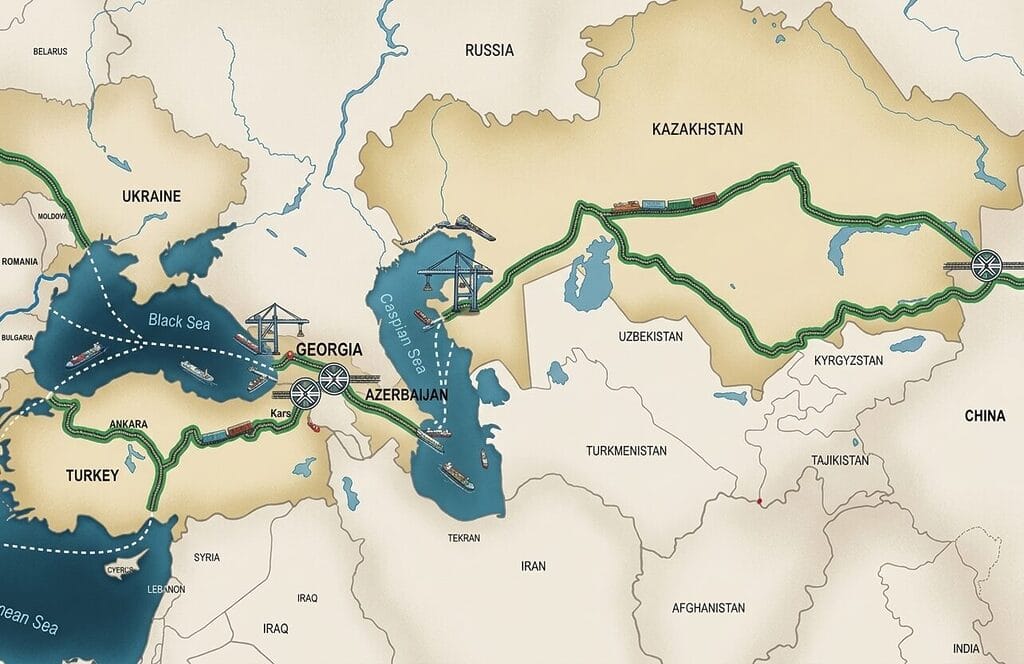
Trade between China and Europe has traditionally relied on two main pillars: A maritime route through the Indian Ocean and the Suez Canal and rail transit through Russia. The fragility of both, however, was laid bare in 2022–2024, with sanctions and legal complexities for Western insurance and logistics companies raising the stakes in the Northern Corridor, which until 2022 had accounted for more than 86% of land transport between China and the EU. At the same time, attacks in the Red Sea forced carriers to round the Cape of Good Hope, increasing transit time by 10-20 days and driving up operational costs.
A natural solution has presented itself in the Middle Corridor, which passes through China, Kazakhstan, the Caspian, Azerbaijan, Georgia, and on to Europe through Turkey or the Black Sea. Once a pipe dream, in 2026 the route enjoys support from the governments of all involved and international financial institutions. The World Bank predicts freight traffic along this corridor will grow threefold by 2030 to 11 million tons annually.
| Route Characteristics (2026) | Northern Corridor (via Russia) | Southern Sea Route (Suez/Cape) | Middle Corridor (TITR) |
| Transit time (China – EU) | 14–18 days | 35–45 days (via the Cape) | 10–15 days |
| Stability and security | Low (sanction risks) | Variable (military risks) | High (geopolitical support) |
| Infrastructure potential | Stagnation | Port congestion | Active growth and modernization |
| Regulatory environment | Complex (sanctions compliance) | Standard (IMO/maritime law) | Liberal (in Georgia/Azerbaijan) |
A comparative analysis of jurisdictions: Why Georgia wins out over Central Asia
Investors considering where to set up shop most often compare Georgia with its main partners in the Middle Corridor — Kazakhstan and Uzbekistan. Despite Kazakhstan’s status as a door to the corridor from China and rapid growth in Uzbekistan, Georgia has a number of unique advantages to offer business.
Kazakhstan: Tax pressure and distances
In 2025-2026, Kazakhstan was forced to tighten its financial policy. The country’s new Tax Code provides for:
- An increase in VAT to 16% and maintenance of income tax at 20%. For small and medium-sized logistics businesses, this is a serious additional burden.
- Vast distances and low road density place Kazakhstan 80th in the global logistics efficiency rating.
Uzbekistan: Dependence on neighbors
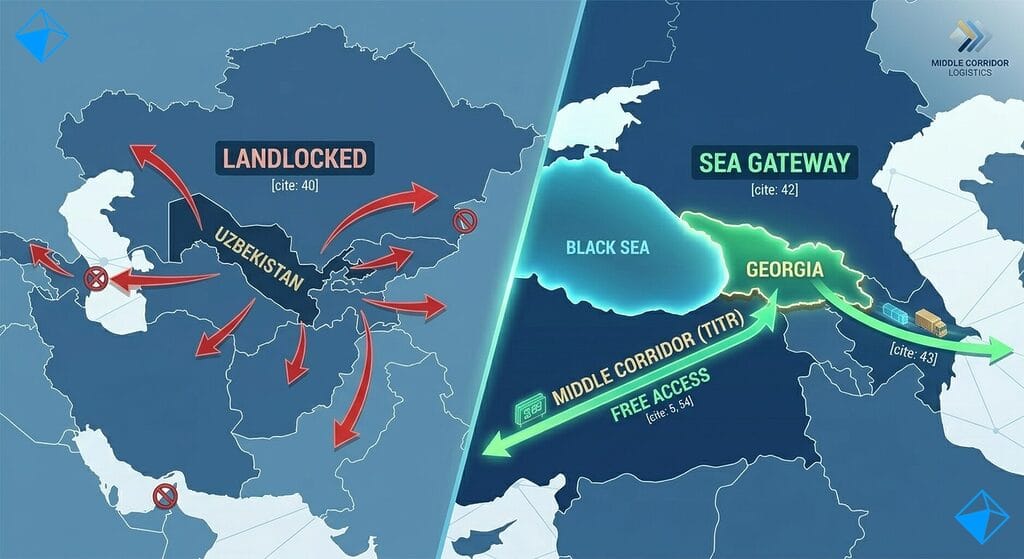
Uzbekistan is a double-landlocked country with no direct access to the ocean, making it completely dependent on neighboring states for transit. So long as access to the sea remains complex and indirect, no amount of new infrastructure will help.
Georgia: Maritime gateway of the region
In this respect, Georgia looks advantageous, serving as a maritime gateway for the entire Caucasus and Central Asia.
- Direct access through the Black Sea to global markets
- Georgia is already integrated into the European TEN-T transport network, which opens the shortest path for goods to the EU
Uniqueness of Georgia’s trade agreements
Georgia remains the only country in the region to have created an unprecedented network of free trade agreements covering markets with a total population of over 2.3 billion people.
- The European market: The 2016 Deep and Comprehensive Free Trade Area (DCFTA) agreement with the European Union completely eliminates duties on 100% of industrial goods and most agricultural products. For a logistics business, this means that Georgia can be used as a primary distribution hub for goods destined for Europe without incurring additional customs expenses.
- China: Georgia was the first country in Eurasia to sign a free trade agreement with China, with terms expanded in 2025 to include e-commerce and investments. Today, there are essentially no tariffs on 96.5% of Chinese exports.
- The CIS and Turkiye: Georgia maintains a free trade regime with Turkiye all CIS member states, ensuring seamless transit of goods across the entire East-West axis.
| Tax Burden (2026) | Georgia | Kazakhstan | Uzbekistan |
| Corporate Income Tax | 15% (only on distributed) | 20% | 15% |
| VAT (Standard rate) | 18% | 16% | 12% |
| Dividend Tax | 5% | 5–15% | 5–10% |
| Property Tax | up to 1% | up to 1.5% | up to 2% |
Georgia, logistics, and tax benefits
The Georgian tax system is considered one of the most efficient in the world thanks to the so-called Estonian Model, which encourages businesses to invest money in their own development rather than just give it to the state. For logistics companies, which require significant capital investments in transport, warehouse capacities, and IT infrastructure, it is an ideal model.
The Estonian Model: Pay taxes only when you take the profit

In most countries, you pay tax as soon as you receive a profit. Not in Georgia:
- 0% tax on development: As long as the profit remains within the company and is spent on the business, you pay no income tax (15%)
- Tax only on dividends: You pay 15% only at the moment when you decide to pay out the profit to shareholders
This allows operators to upgrade equipment and expand warehouses faster with money that would have gone to taxes elsewhere.
Free Industrial Zones (FIZ): An oasis for re-export
An FIZ (in Poti, Kutaisi, or Tbilisi) can provide maximum benefit to companies engaged in international trade and the transit of goods without deep processing in the country:
- 0% income tax – Full exemption from tax on income from exports or the resale of goods within the zone
- 0% VAT and duties – The import of goods into the zone and their use on its territory are not subject to VAT
- 0% on dividends and property – Owners of companies in a FIZ do not pay taxes on distributed profits and their assets within the zone
It is important to note that a tax of 4% of the revenue is payable when selling goods from an FIZ (Free Industrial Zone) to the local Georgian market.
Infrastructure Breakthrough 2026: Ports, Railways, and Highways
In 2026, the success of the logistics business in Georgia directly depends on large-scale state projects. The country is in the process of transforming from an ordinary section of road on a transit route into a full-fledged regional hub, where cargo is distributed in all directions.
The Anaklia Deep-Sea Port: The Future of the Black Sea
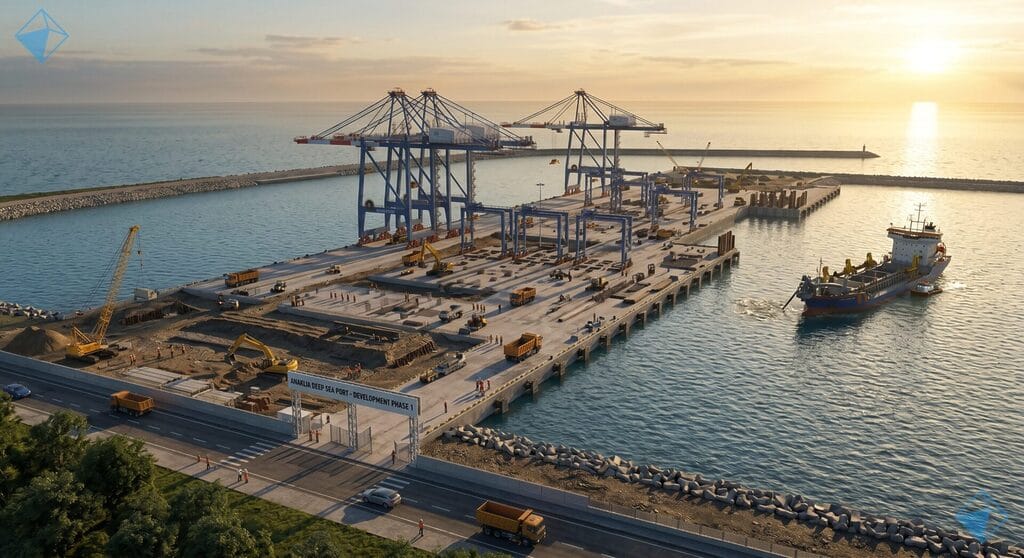
The Anaklia Port project is a central element of Georgia’s transport strategy. By the beginning of 2026, the government had already approved the main contractors and secured financing for the start of offshore works.
- Technical parameters: A depth of 16 meters will allow the port to receive large vessels (Post-Panamax) that currently cannot enter the ports of Poti and Batumi
- Capacity: The port will initially be able to handle approximately 7.8 million tons of cargo (or 600,000 TEU), with capacity to grow to 100 million tons
Schedule: The first dredger will begin the active phase of work in July 2026, and the port will receive its first ship in 2029
Baku-Tbilisi-Kars (BTK) Railway and TITR
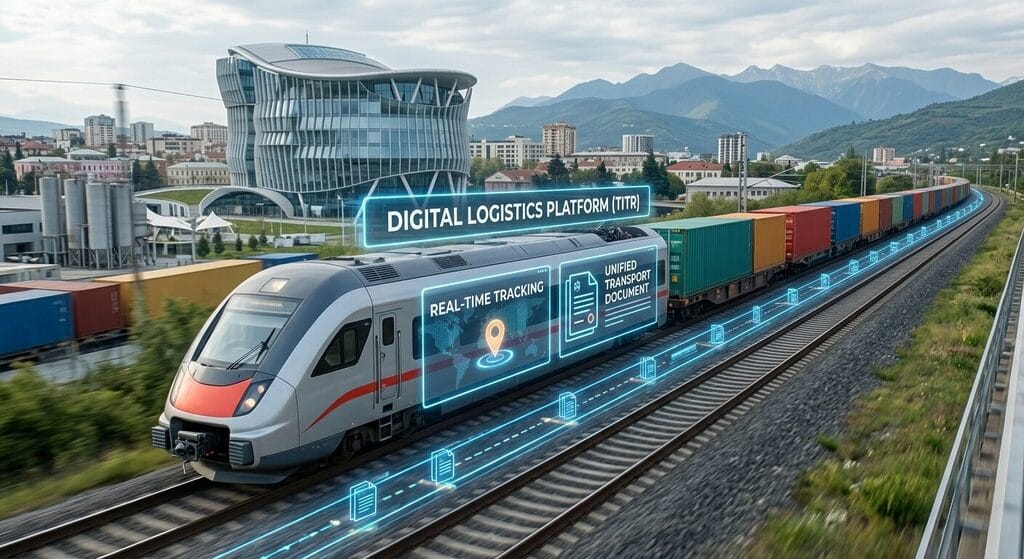
The modernization of the BTK railway with financial support from Azerbaijan increased annual throughput from 1 million to 5 million tons, creating a reliable land bridge from Central Asia to Turkey and Southern Europe bypassing ferries.
A unified digital platform was implemented for the TITR in 2025-2026 that allows for real-time cargo tracking and the use of a single transport document along the entire route from China to Georgia, cutting processing times at borders from an entire day to less than one hour.
Road Network: High-Speed Highways
Georgia is actively building modern concrete highways that connect eastern borders with western ports. In 2026, the focus is on the Tbilisi bypass road project, for which 15.1 million USD has been allocated with the support of the Asian Development Bank. These projects are aimed at eliminating bottlenecks and increasing the average speed of transit.
| Infrastructure | Status as of 2026 | Expected Effect |
| Anaklia Port | Phase of dredging and breakwater construction | Receiving Post-Panamax vessels, 3x capacity growth |
| BTK Railway | Modernization completed | Throughput capacity growth up to 5 million tons |
| Tbilisi Bypass | Active construction phase (Lots 4, 5) | Reduction of transit time through the capital by 40% |
| Poti FIZ | Expansion of terminal capacities | Attracting international distributors |
Procedural aspects of company registration for non-residents
Georgia remains one of the easiest countries for starting a business. In 2026, the procedure is still just as transparent: Foreign nationals do not need to obtain special investment permits or seek local partners. Everything can be done quickly and often remotely.
Registration at the House of Justice
The Public Registry is responsible for registration. In Tbilisi and other cities, this is done through branches of the House of Justice.
- Timelines: It is usually possible to register a company within one working day. There is an expedited procedure that costs GEL 110–400 to get the documents in just a few hours.
- Documents: If you are opening a company in your own name, only a foreign passport is required. If the founder is a foreign legal entity, you will have to prepare a package of documents from that company; they must be translated into Georgian, notarized, and have an apostille.
Getting it done remotely: You do not necessarily have to fly to Tbilisi. You can issue a power of attorney to a local representative who will do everything for you. Many logistics firms choose this path to prepare the ground even before the management arrives.
Banking services and compliance
In 2025-2026, the largest banks (Bank of Georgia and TBC) began vetting new clients more strictly. This is due to international requirements for combating money laundering and sanctions control.
Main requirements:
- Confirm the existence of real economic activity (substance) in Georgia
- Provide information about counterparties and transportation routes
- Disclose the beneficial ownership structure down to natural persons
Despite the strictness of the checks, Georgia remains a friendly jurisdiction for companies operating within the framework of legal international trade corridors, such as the Middle Corridor.
| Service / Fee | Cost in 2026 | Execution Time |
| LLC Registration (standard) | GEL 60 | 24 hours |
| LLC Registration (expedited) | GEL 110 | 2–4 hours |
| Legal Address (annual service) | USD 300 – 600 | Instantly |
| Opening a Business Account | Depends on the bank’s tariff | 2–7 working days |
Why 2026 is the decisive moment to start
If you look at the map of world trade today, it becomes clear: Georgia occupies a unique position. While neighboring countries like Kazakhstan or Uzbekistan function as transit lanes, Georgia is the Middle Corridor headquarters opening a direct path to Europe.
Why exactly now in summary:
- Routes have finally matured: By 2026, the Middle Corridor has ceased to be an experiment. It is a fast, reliable system supported by governments and banks.
- A market of 2.3 billion buyers: Thanks to updated agreements with China and free trade with the EU, your company can transport goods in both directions without customs duties, something you won’t find anywhere else in Eurasia.
- Infrastructure of the future: Construction on the Anaklia Deep-Sea Port begins in July 2026, and digital systems already allow for border crossings in less than an hour.
- Taxes work for you: The Estonian Model means no income tax if you reinvest in the development of your fleet or warehouses. Additionally, the special status of an International Company can reduce taxes to a record 5%.
Businesses looking for long-term stability and access to global capital in 2026 will find Georgia without peer in Eurasia. Registering a logistics company today is a strategic solution to the problem of locked routes and insurance against sanctions.
Simple registration procedures let you launch within a few days, placing you at the very center of the New Silk Road.
Start operating in the Middle Corridor without unnecessary risks and entrust the registration of your logistics company in Georgia to the experts at PB Services. Sign up for a free consultation with a specialist.