


As word of Georgia’s low taxes spreads, more expats are choosing to move here for tax purposes. According to the National Bank, some 25% of foreign nationals in the country already have tax residency. The purpose of this article, then, is to warn you that simply moving to Tbilisi isn’t enough to avoid having to pay taxes in your home country. There are legal formalities you’ll want to follow to prove that you’ve really moved your center of vital interests to Georgia.
Why foreign nationals are opting for Georgia
According to the Tax Foundation, Georgia ranks in the top 6 in Europe for lowest personal income tax and the top 30 globally, according to the World Bank. And that is just for Georgia’s basic personal income tax rate of 20%.
As we’ve written many times before, any foreign national opening a sole proprietorship here can count on a tax rate of just 1%. And this is the first reason people are opting for Georgia.
Perhaps more importantly, though, the territorial taxation enshrined in Articles 82 and 104 of the Tax Code of Georgia means you will only have to pay taxes on income earned domestically.
In other words, your global income is not subject to taxation, be it:
- Interest on deposits in a bank abroad
- Pension contributions in your home country
- Royalties not related to activities in Georgia
- Dividends from foreign companies and profit from the sale of international securities
- Income from the sale of crypto-assets, including those purchased in Georgia (!)
It is important to note that income you earn while working remotely in Georgia for a foreign company is recognized as income from a Georgian source, and you’ll have to pay tax on it. If you have passive assets, though, a change of residency could be a very good option with long-term benefits.
Changing residency is about more than moving
Perhaps you’ve already read on the Internet that spending 183 days in a place during a calendar year makes you a tax resident. That is technically true. But you should know that if you simply move to Georgia for six months and stop paying taxes in your home country, there is a risk of administrative and even criminal liability.
The fact is that many countries will continue to consider you a tax resident after your departure, so-called dual residency. To forestall potential questions from the tax authorities, you must confirm that the center of your vital interests has moved to Georgia. What you need to do that are documents.
Getting ready to relocate for tax purposes
A basic list of the documents that can attest that you have moved your center of vital interests:
- Proof of lawful presence in Georgia: a residence permit, a visa, a stamp in a passport showing you crossed the border, a certificate of registration of an individual entrepreneur or a company
- A place of residence in Georgia: paid utility receipts or a notarized apartment rental agreement for the entire period of stay in the country, or a certificate from the Georgian registry of owners, if you own real estate
- Proof of financial activity: a statement of cash flow from a local bank (TBC, Bank of Georgia, SOLO, among others), a certificate of personal or corporate bank accounts or account with a broker. For investors in cryptocurrency, documents from Georgian crypto exchanges confirming your activity (e.g., off-ramp crypto and fiat transactions)
- Up-to-date tax declarations: even zero declarations are obligatory for IEs with no income and confirm compliance with local tax regulations. If you are working in a business, a salary certificate will do
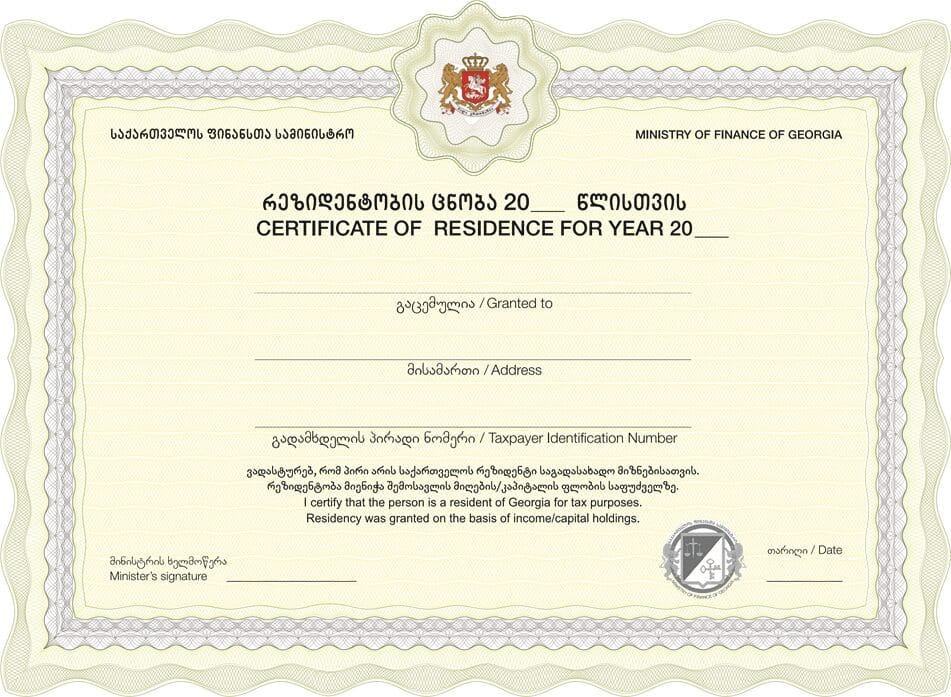
- The tax residency certificate: this is the best and most important and shows that the Georgia Revenue Service officially considers you a resident for a given period
How to obtain a tax residency certificate
All you need to do is apply online through the Revenue Service portal RS.ge or drop by the tax office in person. You can also have an authorized representative pick the document up for you. In rare cases, the regulator may want to see more than just your passport and ask for the documents described above. It usually takes between 5 and 15 working days to actually get the certificate in your hands.
Is it possible to change residency without moving to Georgia?
The short answer is yes but not for everyone. The country has a unique tax residency program for High-Net-Worth Individuals, or simply HNWI, that grants the status without the 183-day stay in Georgia.
You’ll need to satisfy three criteria:
- Possess global assets of at least GEL 3 million (more than USD 1 million) or an annual income of GEL 200,000 (approximately USD 93,000) for the past three years
- Possess assets in Georgia worth at least USD 500,000
- Have a residence permit orbusiness income in the country of at least GEL 25,000 (USD 9,300) for the previous year
What to do with the documents now that you have them
Notify the tax authorities in your previous place of residence that you’ve moved the center of your vital interests to Georgia. The procedure will vary by jurisdiction, but the documents listed above should be sufficient regardless.
If you live in Georgia for a long period of time, we recommend obtaining a tax residency certificate, valid for a given tax period only,every year just to be safe and legally prepared for every eventuality.
Possible consequences of mistakes
You can’t expect the tax authorities back home to just find out about your change of residency and be proactive in accounting for it. Even if everything seems to be in order at the moment, information about your income does not spread between countries instantly, and things can get complicated down the road.
A simple but illustrative case study: A French citizen moved to Georgia for one year, and then, in the spirit of the digital nomad, moved on. While living in Georgia, he invested in bitcoin and earned USD 5,000 on the sale. In Georgia, individuals do not pay tax on crypto profits, but in France they are taxed at a “flat rate” of 30%.
Now let’s consider two possible outcomes:
- In the first, he collected all the documents and notified the French authorities of the change of his center of vital interests. Everything was hunky-dory.
- In the second, he kept mum, eventually finding out that the French tax authorities wanted money from him, and in addition to the regular 30%, he was hit with a penalty of 80% for undeclared activity and a 2.4% late payment penalty, resulting in damages of USD 2,736, or more than half the profit. Meanwhile, the maximum penalty for tax evasion in France is EUR 500,000 or 5 years in prison…
And France is not the only country actively defending its tax interests wherever they may crop up. Spain, Germany, the UK – the list is long of countries that continue to expect something of their citizens spending the lion’s share of the year abroad but maintaining some kind of tie with the home country. And then there’s the United States, which taxes the worldwide income of its citizens regardless of where they are or how long they’ve been there. Though even in this case, it is possible to file correctly with the IRS and take advantage of various benefits, like the FEIE (Foreign Earned Income Exclusion).
Conclusions: Planning for your big move
Georgia is a great jurisdiction for foreign nationals who earn passive global income and want to reduce the tax burden from bank deposits, dividends, or other investments. To take advantage of the perks of Georgian tax residency, though, you’ll need to prove a connection to the country and legal residency or face penalties and in some cases find it difficult or even impossible to obtain tax exemption in your home country.
We suggest taking the issue of relocation seriously and considering it ahead of time. The qualified lawyers of PB Services can help draw up a reasonable plan for your relocation taking into account the country of your current tax residency and help you to collect the documents you’ll need in Georgia. A 30-minute consultation is free of charge!