


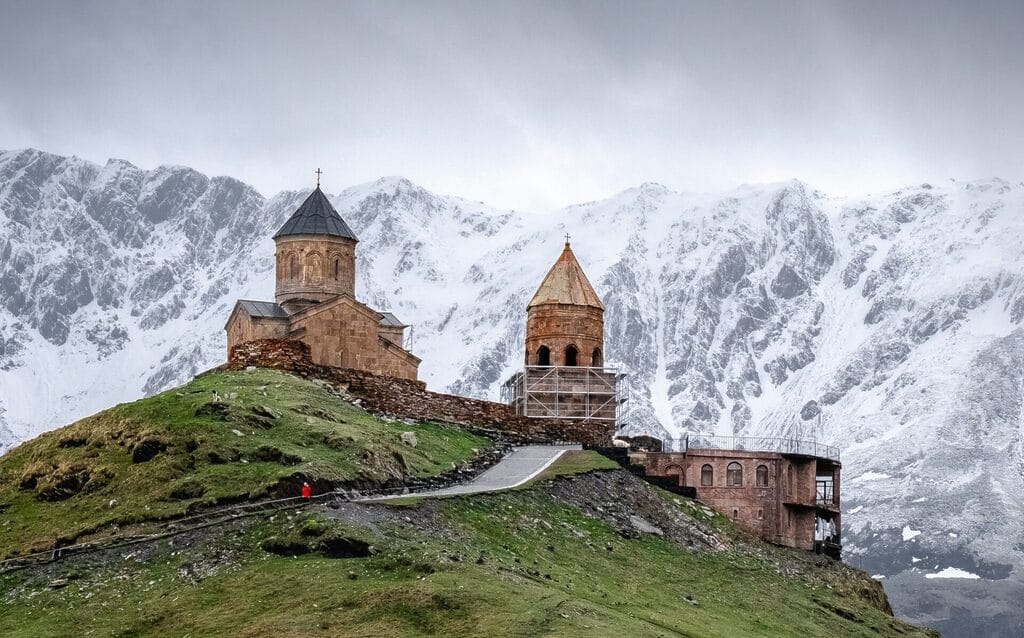
Georgia’s mind-boggling diversity
There are tourists in Georgia throughout the year, with at least one million travelers in the country at any given time regardless of the season, according to the National Statistics Service. What may vary is where exactly the season takes them.
Despite its size, Georgia has one of the world’s most diverse biospheres. According to the UN, two-thirds of the country can be classified as mountainous, 20% of which is 2,000+ meters above sea level. 43% is agricultural (and includes pastures and grasslands), another 43% is forest, and the total soil diversity reaches 49.
The great variation stems from the number of climate zones. Researchers have identified anywhere from 12 to 37, the largest being humid subtropical and continental according to the Köppen climate classification, with temperatures varying considerably from location to location.
In this new article, we tell you a bit about how the weather can vary from region to region within Georgia, so you can make an informed decision when planning your short trip or choosing a place to live.
Georgian weather at a glance
WorldData.info has information for the country as a whole for the last 20 years, with average values for all the weather stations in Georgia.
- Overall, the country is quite warm, with daytime averages ranging between +27 and +32 °C in summer, +15 and +20 °C in fall and spring, and dropping to +10 °C (+2 °C at night) in winter. The higher you are above sea level, however, the lower the temperature can plunge. Consequently, the numbers above apply more to cities in the valleys.
- As for records, the absolute summer maximum hit +41.6 °C in Kutaisi in September 2022. An all-time low of -14.6 °C was recorded in Bolnisi in February 2014.
- You can usually count on a relative humidity of around 70%. The number of rainy days is generally less than 10, though for more exact measurements, you’ll need to consider the season and region.
Tourism is at its peak in the hottest months, between June and September, when the sky is cloudless, nature in bloom, and the water in the Black Sea 24 °C or higher.
Honestly, you probably want to be there in the off-season, i.e., October-November and March-April, when it isn’t too cold and there aren’t too many tourists. If you’re looking to winter, the popular ski resorts of Gudauri and Bakuriani open in mid-December and close in February – not a bad time.
What to expect from the weather in Tbilisi
And the eastern regions of Kvemo Kartli and Kakheti in general…
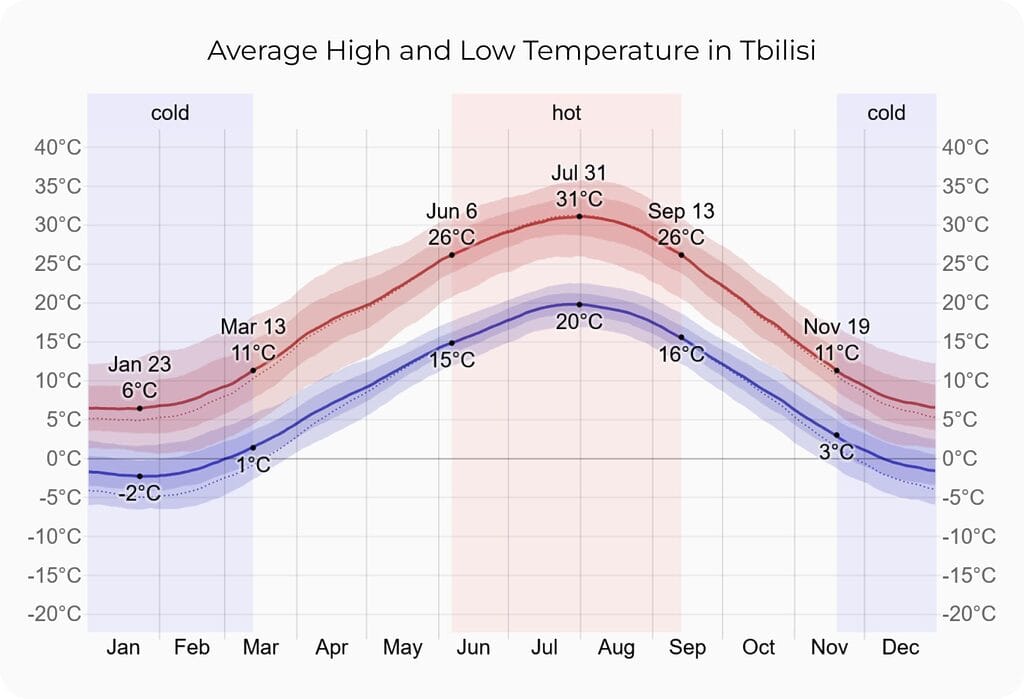
The climate in Tbilisi is temperate continental and drier than in the rest of the country. The mountains protect the Mtkvari River valley from the humid air of the Black Sea, making the summer hot (up to +35-40 °C) and the winter mild, with the possibility of sudden, and extreme, temperature changes.
Rain and snow aren’t so common in Tbilisi and generally limited to late fall. There are an average of 94 rainy days, with the total amount of precipitation clocking in at around 500 mm, almost four times less than in western and northern Georgia.
Interesting fact: The weather in Tbilisi is similar to New York. As per WeatherBase, at least 45 days clock in at +30 °C in Tbilisi, 22 exceed +32 °C, and 70 drop below 0 °C 70. Pretty close to the 40, 25, and 74 for New York.
The climate in Batumi
Batumi, and basically the entire Black Sea coast, including Poti and Kobuleti, couldn’t be more unlike Tbilisi.
Batumi’s proximity to the sea and mountains has resulted in a climate that is subtropical and very humid. The summers are warm, fluctuations in temperature moderate, and winters largely free of frost and rather rainy. Adjara receives an average of 2,000 mm of precipitation a year, spread across 138 days, comparable to Iceland, Vietnam, and Jamaica, and Batumi is sometimes compared to London or other cities of the British Isles.
One advantagef of the high humidity is the abundant greenery in the region. Batumi’s Botanical Garden of about 100 hectares is the stuff of legend, and the city is likewise known as the gateway to the tea-growing region of Guria.

The weather in Kutaisi
Kutaisi is Georgia’s third most populous city and the administrative center of Imeretia. It’s also a good gauge for the weather in the neighboring regions of Samtskhe-Javakheti, Racha-Lechkhumi, and the aforementioned Guria.
Kutaisi is characterized by a humid subtropical or warm temperate climate and is considered the golden mean between Tbilisi and Batumi. The summers are quite warm, but not as hot as in Tbilisi or as humid as in Batumi. Winter is relatively mild, although heavy rain and snow are possible. In general, precipitation is evenly distributed throughout the year, with about 1,400 mm falling in 12 months.

The weather in mountainous areas
As already mentioned, Georgia is two-thirds mountainous, with massifs scattered across the country, especially in Samtskhe-Javakheti (Bakuriani), Svaneti (Mestia), Mtskheta-Mitianeti (Gudauri and Stepatsminda, home to Mount Kazbek).
A difference of 10-15 °C can separate the highlands from neighboring valleys. According to the classic vertical temperature gradient, there is a drop of 0.6 °C on average for every 100 meters of elevation.
Consequently, the temperature rarely rises above +22 °C in summer and often drops to -15 °C in winter in these regions 1,500+ meters above sea level. So whatever time of year you go to the mountains, don’t forget to pack warm and check the forecast.

Temperature by city and season
This table contains theaverage temperatures for different cities in Georgiaas listed on WeatherSpark.com. The low is for night and the high for daytime.
Naturally, there can be some serious deviations – as high as 10 °C, but as a rough guide, you can use these temperatures to get a general idea of what to expect.
| City name | January | April | July | October |
| Tbilisi | From -2 °C to +6 °C | From +7 °C to +18 °C | From +19 °C to +30 °C | From +9 °C to +19 °C |
| Batumi | From +5 °C to +10 °C | From +9 °C up to +16 °C | From +20 °C to +26 °C | From +13 °C to +20 °C |
| Kutaisi | From +1 °C to +9 °C | From +8 °C to +19 °C | From +19 °C to +29 °C | From +11 °C to +21 °C |
| Zugdidi | From +3 °C to +9 °C | From +8 °C to +17 °C | From +20 °C to +27 °C | From +12 °C to +20 °C |
| Bakuriani | From -13 °C to -3 °C | From -1 °C to +10 °C | From +11 °C to +22 °C | From +1 °C to +12 °C |
| Gudauri | From -14 °C to -6 °C | From -3 °C to +4 °C | From +8 °C to +17 °C | From -1 °C to +6 °C |
| Telavi | From -2 °C to +5 °C | From +7 °C up to +16 °C | From +18 °C to +28 °C | From +8 °C to +17 °C |
| Gori | From -3 °C to +5 °C | From +6 °C up to +16 °C | From +18 °C to +29 °C | From +8 °C to +18 °C |
Conclusion: The best time to visit Georgia
Thanks to the abundance of climatic zones, Georgia hosts visitors throughout the year:
- Spring is a great time to visit pretty much anywhere in Georgia. In March-April, apple orchards, irises, and lilacs begin to blossom, a comfortable +20 °C passing from west to east.
- Hide from the summer heat on the Black Sea coast (Batumi, Kobuleti, Poti) or visit the mountains for some spectacular canyons and waterfalls.
- Autumn is an ideal time to visit Tbilisi or Kutaisi. The air is warm and the new wine, many fairs, and harvest festivals pleasant distractions.
- Batumi and Kutaisi are good in winter, if rainy, and a relatively mild European winter awaits in Tbilisi. Ski buffs will find satisfaction in the well-established Bakuriani and Gudauri or the relatively new resort of Goderji in the mountains of Adjara.
If you need legal assistance in Georgia, just use the form below to get in contact with PB Services.